
Prince Harry’s war with UK press is over, and he’s lost

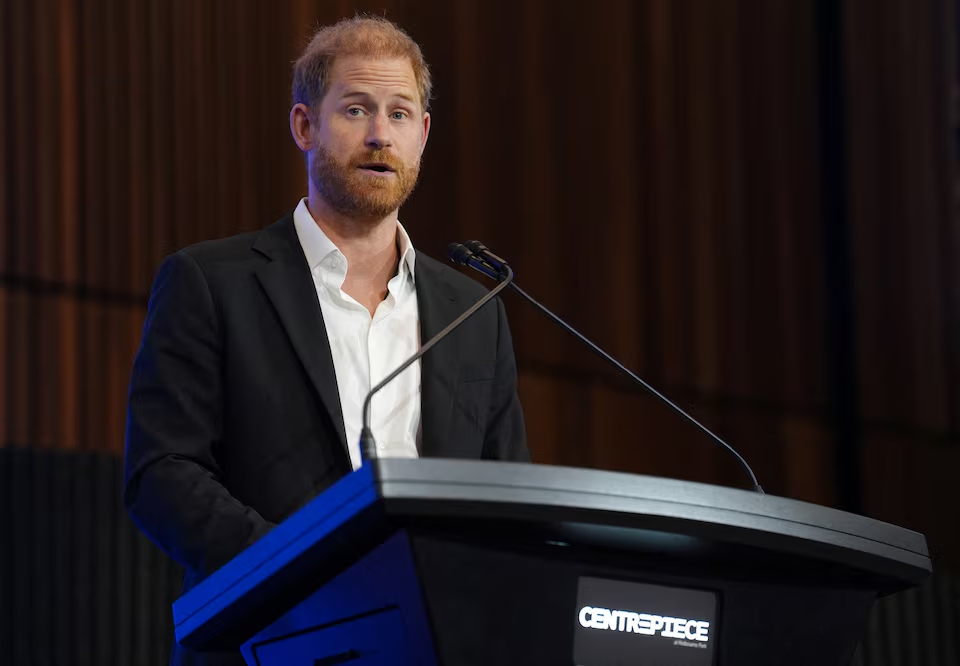
Eight years after Prince Harry launched a legal campaign against Britain’s tabloid press, securing several high-profile courtroom victories along the way, his broader effort to hold powerful media figures accountable has suffered a major setback.
The latest blow came on Tuesday when he lost a key case against Associated Newspapers, publisher of the Daily Mail, a ruling widely regarded as the most significant of his legal battles. The court rejected all 97 claims brought by Harry, Elton John, and five other prominent claimants against the newspaper.
Harry’s strained relationship with the British media has long been deeply personal. He has repeatedly blamed relentless press intrusion for contributing to the death of his mother, Princess Diana, who died in a 1997 car crash in Paris while being pursued by photographers. He has also said persistent media attention damaged his friendships and his relationship with former girlfriend Chelsy Davy.
His legal action intensified after what he described as sustained attacks on his wife, Meghan Markle, whom he accused sections of the British press of targeting with racist and misogynistic coverage.
During testimony in the Associated Newspapers case, Harry became emotional as he described the toll the media scrutiny had taken on Meghan, saying the continued attacks had made her life “an absolute misery.”
In witness statements across his various legal cases, Harry argued that his campaign extended beyond personal grievances, framing it as a fight for truth, accountability and justice for thousands of people whose privacy had been violated by unethical journalism.
He maintained that allowing influential media organisations to evade accountability would have wider consequences for society.
Throughout his legal campaign, Harry openly criticised several senior media executives, including former Daily Mail editor Paul Dacre, broadcaster and former Daily Mirror editor Piers Morgan, and Rebekah Brooks, chief executive of News UK and former editor of The Sun.
However, while some cases resulted in admissions of unlawful practices by newspaper groups, none produced the sweeping accountability Harry had sought. No senior editors faced criminal investigations, and those he criticised remain influential figures within the media industry.
In Tuesday’s ruling, the judge described Dacre as a “straightforward and generally careful witness.” Dacre welcomed the judgment as a complete vindication of the Daily Mail‘s journalism and sharply criticised Harry, accusing him of publicly exposing his private life while complaining about media intrusion.
Despite Harry’s legal efforts, public and media interest in the British royal family has only continued to grow. Royal coverage dominates newspapers, websites, podcasts and blogs, with Harry and Meghan frequently attracting negative headlines.
Supporters of the Duke of Sussex have often pointed to what they view as contrasting media treatment of Meghan and Catherine, Princess of Wales, arguing that similar stories involving the two women have been portrayed very differently.
Media lawyer Mark Stephens said Harry’s earlier legal victories demonstrated that newspapers had engaged in unlawful practices, but argued that today’s media landscape differs significantly from the era surrounding Princess Diana’s death.
According to Stephens, Harry’s campaign reflects a deeply personal attempt to address what he believes was the media’s role in his mother’s death.
The prolonged legal battle has also come at considerable personal and financial cost. Associated Newspapers estimates the latest case alone generated legal fees of about £50 million.
Harry’s campaign has also further strained relations within the royal family. Since stepping back from royal duties in 2020 and relocating to California, he has accused some family members of cultivating close relationships with the press in exchange for favourable coverage—criticisms that contributed to his rift with Prince William and King Charles III, who, according to Harry, had warned him that taking on the British press would likely be “a suicide mission.”
Source: Reuters
About The Author


