
Costa Rica’s new president clashes with judiciary over tackling drug violence

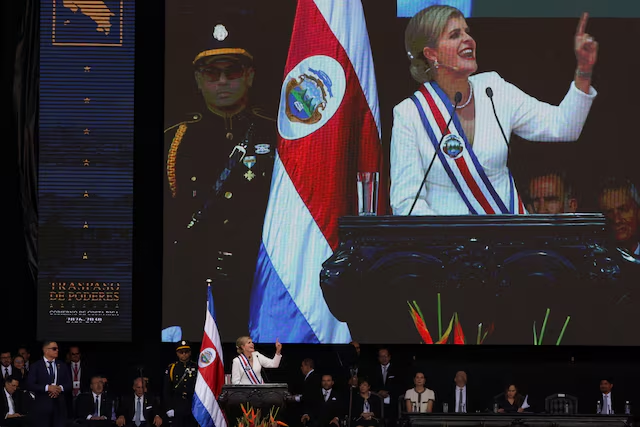
A growing confrontation between Costa Rica’s newly elected President, Laura Fernandez, and the country’s judiciary is hindering a unified government response to rising drug-related violence in the Central American nation, once regarded as one of the region’s safest countries.
Analysts say the dispute reflects a wider challenge facing Central America, a key transit route for cocaine destined for the United States, where organised crime, violence and corruption have increasingly strained state institutions.
Just two months into President Fernandez’s administration, tensions have escalated over substantial budget cuts affecting the judiciary and a proposed constitutional reform that would transfer the power to appoint the attorney general from the Supreme Court to Parliament.
The standoff intensified last week after Fernandez accused the judiciary of being deeply compromised by organised crime and criticised the courts for obstructing her government’s tough anti-crime measures, which are modelled on the security approach adopted by El Salvador’s President Nayib Bukele.
Judicial officials have strongly denied the allegations, challenging the President to provide evidence and warning that planned funding cuts for 2026 and 2027 could weaken democratic institutions and undermine efforts to combat crime.
Fernandez won the presidency on a pledge to tackle escalating violence and restore public security in the country of 5.2 million people, where an average of two homicides are recorded each day. The homicide rate has remained close to the record level of 17.2 deaths per 100,000 people reached in 2023—twice the figure recorded a decade earlier.
Security Minister Gerald Campos told Reuters that only 38 per cent of homicide cases end in convictions, arguing that the country’s main challenge lies in the judicial system rather than the absence of a military.
Government officials, judicial authorities and security experts agree that Costa Rica’s strategic location has made it an increasingly attractive route for international drug trafficking networks transporting narcotics to markets in North America.
Evelyn Villarreal, coordinator of the State of Justice report, warned that divisions among state institutions only strengthen criminal organisations with vast financial resources.
Shortly after taking office, President Fernandez called for the resignation of Attorney General Carlo Diaz and several Supreme Court judges, accusing them of failing to adequately address the country’s worsening security situation. None of the officials have stepped down.
Patricia Solano, president of Costa Rica’s highest criminal court, rejected claims that the judiciary is responsible for the crime wave and argued that the government was attempting to weaken an independent democratic institution.
She said the judiciary had faced sustained political pressure since 2022 under the previous administration of former President Rodrigo Chaves, who belongs to the same political party as Fernandez.
Solano also noted that the country’s prison population has grown by 36 per cent since 2020. According to the World Prison Brief, Costa Rica ranked 22nd globally in incarceration rates in 2024, with 366 prisoners per 100,000 inhabitants.
Meanwhile, many citizens say they are frustrated that the ongoing political dispute is distracting leaders from addressing the country’s growing security concerns.
Karina Bolaños, a shop owner in Goicoechea, north of the capital San José, said the political infighting had done little to improve public safety, adding that the country had deteriorated despite repeated promises to tackle crime.
About The Author


