
Alberta votes overwhelmingly to remain part of Canada in historic referendum

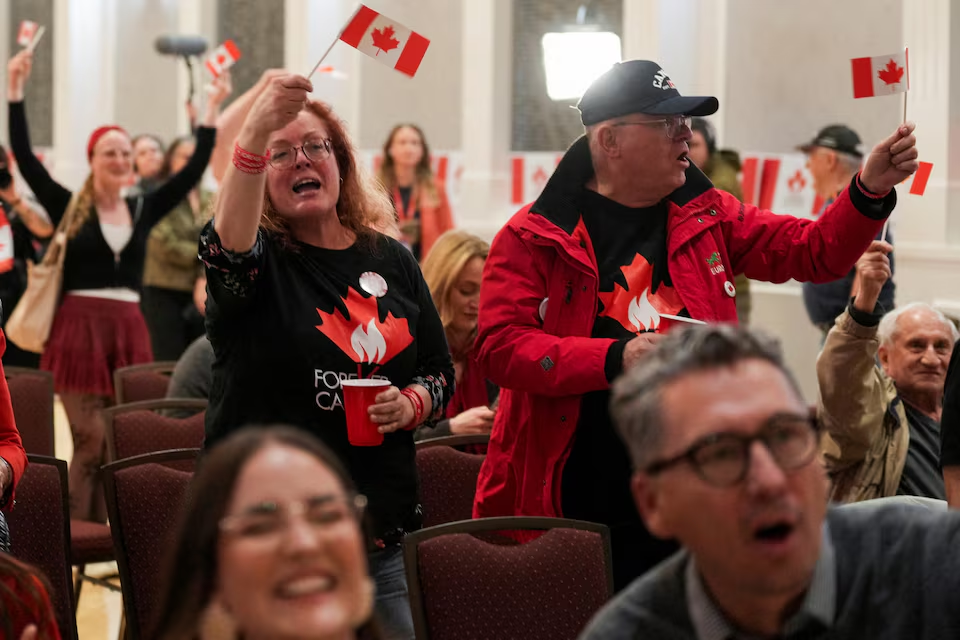
Residents of Alberta have voted overwhelmingly to remain part of Canada in the province’s first-ever referendum on separation, delivering a significant victory for Prime Minister Mark Carney as he seeks to strengthen national unity amid a trade dispute with the United States.
As of 5:45 a.m. on Tuesday, with about three-quarters of the votes counted, 76% of voters had supported remaining in Canada, while 24% favoured a binding vote on separation. The referendum itself was non-binding.
Reacting to the results, Carney said Albertans had made a clear decision in favour of unity and working together to build the country.
He added that Canada’s strength came from the combined contributions of its provinces and territories.
Opinion polls and political analysts had largely ruled out a victory for separatists, citing surveys suggesting that only about one-third of residents in the western, energy-rich province supported holding a future referendum on independence.
Alberta Premier Danielle Smith, who announced the referendum in May, welcomed the early results, saying she was pleased with the strong support for remaining part of Canada.
Smith said she would address residents later on Tuesday to discuss the province’s future direction.
A small but vocal separatist movement has spent months campaigning for Alberta to become an independent country. Supporters argue that the province’s energy wealth subsidises less affluent parts of Canada and that independence would free it from what they consider excessive federal bureaucracy.
Last week, Carney warned at a rally in Calgary that leaving Canada would be a dangerous gamble that could lead to years of deep divisions.
Carney seeks to reduce Canada’s reliance on US
The vote comes as Carney works to reduce Canada’s economic dependence on the United States amid growing trade tensions between the two countries.
US President Donald Trump has repeatedly spoken about the possibility of annexing Canada, although he had not immediately commented on the Alberta referendum results.
US Treasury Secretary Scott Bessent had previously expressed support for Alberta joining the United States, saying in January that the province should be allowed to become part of the country.
Monday’s referendum was the second separatist challenge Carney had faced within two weeks. In Quebec, a predominantly French-speaking province, an independence-oriented party won power on October 5 but failed to secure the majority required to fulfil its promise of holding a referendum on separation.
Quebec previously held independence referendums in 1980 and 1995, both of which were unsuccessful.
Carney, who spent much of his childhood in Alberta, has acknowledged that residents of the province have often felt overlooked by the federal government in Ottawa.
He has pointed to his government’s decision to fast-track a proposed new oil pipeline, in which Alberta and the federal government would be majority owners, as part of efforts to address the province’s concerns and reduce Canada’s dependence on the US.
Indigenous First Nations groups have also opposed Alberta’s independence campaign, arguing that their land treaties with the federal government predate the province’s establishment within Canada.
Alberta independence movement likely to continue
Despite the decisive result, the referendum is unlikely to bring an end to the independence movement. Some separatist leaders had indicated before the vote that they would continue pushing for another referendum even if most voters rejected separation.
A survey released on October 16 by pollster Angus Reid found that 62% of Albertans believed the separatist movement would never disappear.
Monday’s ballot also included nine additional non-binding questions on proposed measures intended to strengthen Alberta’s position in negotiations with the federal government.
The questions covered immigration, access to provincial services such as education, healthcare and social assistance, as well as voter identification requirements.
Preliminary results indicated that voters supported eight of the nine proposals, although some secured only narrow majorities.
Source: Reuters
About The Author


