
The rising cost of protests: A look at violent protest crackdowns in Togo and Kenya


Protesters in Kenya
The power and price of protests
Protests are one of the clearest expressions of public dissent in any democracy. They are often led by the people who feel the weight of policies most heavily such as students, the unemployed, low-income workers, and the youth. Their voices rise when other channels are shut. And most times, what they seek is not chaos but change.
However, the reality of protests across Africa is becoming increasingly dangerous. Instead of being listened to, protesters are often silenced, sometimes permanently. The streets of Togo and Kenya are echoing a disturbing truth: the cost of protest is becoming death, injury, and detention.
Ghana’s own waves of resistance

Ghana, often hailed as a stable democracy in the region, has not been immune to protests. On September 21, 2024, Democracy Hub, a civil advocacy group, organized the “Say No To Galamsey” demonstration to demand stronger government action against illegal mining. Protesters were blocked by police before they could reach Jubilee House. By day two, arrests had begun.
Weeks later, on October 3, a three-day protest demanding the release of 53 arrested protesters and further action against galamsey began. Marchers moved from Legon Okponglo to Independence Square, passing through high-profile areas under heavy police monitoring. Social media was flooded with hashtags like #FreeTheCitizens and #SayNoToGalamsey.
Togo: The 7 bodies in a river
In Togo, a close neighbor to Ghana, protests have taken a grim turn. France24 reported on June 29, 2025, that at least seven bodies, including a minor, were found in rivers in Lomé. Rights organizations blamed Togolese security forces and militias. Government officials denied responsibility, attributing the deaths to drowning.
From June 26 to 28, citizens took to the streets, calling for President Faure Gnassingbé’s resignation. Tear gas was used; barricades were erected; tyres burned. More than 60 arrests were made.
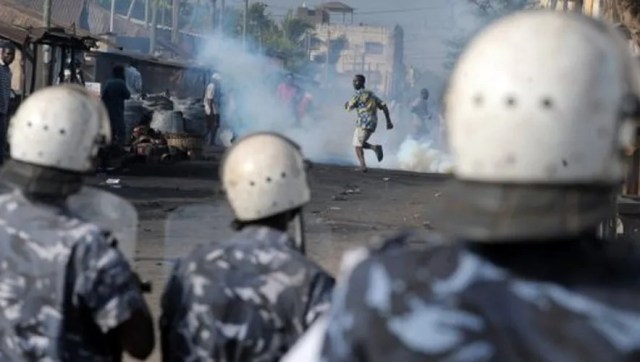
“We’re hungry. Nothing works for Togolese youth any more, that’s why we’re going out to protest this morning,” said Kossi Albert, a 30-year-old unemployed man according to Aljazeera.
The protests came in response to controversial constitutional reforms and worsening economic hardship. Gnassingbé, who has been in power since 2005 was recently sworn in as President of the Council of Ministers, a position with no term limits.This means he could be in power for life.
Kenya: From ‘Hustler’ promise to police brutality
Kenya’s President William Ruto rose to power presenting himself as a “hustler”, a champion of the ordinary citizen. But by mid-2024, that narrative had changed.
Why the youth protests?
At the heart of Kenya’s unrest is economic frustration. The finance bill proposed by Ruto’s government in 2024 aimed to raise $2.7 billion in domestic revenue by introducing or increasing taxes on essentials like internet data, fuel, diapers, and bank transfers. To many, it felt like a direct attack on already strained livelihoods.
“A president should be empathetic with his people. He is here because of us, not because of anything else,” a recent university graduate told Al Jazeera. “I’m a student. Where do I go from here? Some of the people demonstrating are depressed, because there seems to be no future prospects for them,” he added.

The final straw was the death of a teacher in police custody and the shooting of an unarmed vendor, incidents that reignited national anger.
On June 26, 2025, protests intensified. According to Reuters, 16 people died, most of them killed by police. On July 7, another 11 people were killed during demonstrations that coincided with ‘Saba Saba’ Day—a day historically tied to Kenya’s fight for democracy.
According to the Kenya National Commission on Human Rights, at least 31 people died in the July 8 protests. Over 100 were injured, and more than 500 were arrested.
Francis Waswa, a construction worker, told Reuters, “We are not ready to go back [home] because who will fight for our rights then? We will be here till evening.”
Governments’ harsh responses in Kenya and Togo
President Ruto’s reaction was fierce. According to the BBC, He publicly ordered police to shoot protesters in the legs if they were caught damaging property. “Don’t kill them, but ensure their legs are broken,” he said two days ago.

He later declared, “Kenya cannot and will not be ruled through threats, terror, or chaos. Not under my watch.” To him, attacks on security forces equated to a declaration of war.
Despite the withdrawal of the finance bill, public anger has not subsided. Critics argue that Ruto, once seen as a relatable leader, is now increasingly authoritarian.
A similar hardline posture can be observed in Togo. Joynews which sourced Albert Kuzor and Ekou Blame reported yesterday, 10th July, 2025 that Colonel Hodabalo Anate, Minister of Territorial Administration, described the protests as “acts of terrorism.” Social media restrictions were introduced, and international arrest warrants were issued for leaders of the “Mouvement du 6 Juin” (M66) Citizens’ Movement, who had mobilized the demonstrations.
At a press briefing on July 9, Security Minister Calixte Madjoulba confirmed ongoing investigations. “Rest assured, investigations are ongoing. Arrest warrants have been issued. The countries where these individuals reside are urged to cooperate. Wherever they are, we will pursue them,” he said.

Rather than initiating dialogue, the Togolese government appears intent on silencing dissent.
President of the Association of Torture Victims of Togo, Kao Atcholli stated that “Rather than initiating dialogue with actors across the socio-political landscape, particularly the youth-led movements, the authorities are opting for suppression.”
Yet opposition to the administration continues to build, with further protests announced for July 16 and 17.
What does this mean for Africa’s democracy?
In both countries, a pattern emerges: young people take to the streets, calling for accountability, only to be met with teargas, water cannons, bullets, and threats. Governments frame these movements as subversion, not civic participation. Media gets blocked. Protest leaders face arrests. Social media becomes a battleground.
In Togo, it’s a generation saying enough to dynastic rule. In Kenya, it’s youth resisting a government they believe no longer hears them. In Ghana, it’s civil society demanding environmental justice.
These are not isolated events. They speak to a broader crisis of representation and state accountability. When the default response to protest is violence, what is left of democracy?
Conclusion
A protest should never be a death sentence. However, in too many parts of Africa, it is becoming just that. When youth raise their voices, it should be a signal to engage, not a license to crack down. Silence has never solved a crisis. Dialogue, justice, and reform might. And for once, Africa must listen to its youth before her streets turn red.
By Joyce Kpeglo
About The Author


